Derivatives and the Recession

My Related Pages

Please send payment to bitcoin address 17BVQmDP68sSmBw6o2hsEx2Mx4gi6f96Rv
Payment Received [[value]] BTC. Thank You.
[[error]]

Felix qui potuit rerum cognoscere causas.
- Publius Vergilius Maro

Happy is he who can know the causes of things.
Revision 0.33
Copyright © 2009-2012 by .
All rights reserved.

Introduction

We know we're in a Recession, so what caused it? And what factors are influencing it now? Who is profiting and who is losing? Was this recession made to happen? On this page I am presenting my notes that address these questions.

Let us not just assume, as the media would have us do, that poor people who bought houses they could not afford (or rather were suckered into it by predatory lenders) were the main cause of the crisis, or even that they are the sole worthy recipient of blame. That is a story for children, not for we who seek to know the truth. After all, bankers control much of the mainstream media corporations through interlocking directorships: They control the spin.

No, there's much more to the story and the duped poor people may in fact be only a tiny part. It involves a much larger mesh of wrongdoing and outright criminality, involving bankers engaging in derivatives gambling, bailouts for politically-connected racketeers, Ponzi schemes, front-running scams, money laundering on a massive scale, and much more.

Contents
Assets versus goods
The workers
The borrowers
The abusive speculators
The abused savers
Peekaboo accounting scam
The shadow banking system
Market irrationalism
Ponzi schemes
The money supply
What is a market maker?
Zero-reserve banking system
Has Goldman Sachs taken over the US government?
WTC 7 controlled demolition connection
Economic Bubbles
Shady international cabal of financiers
Inflation
What is the Federal Reserve?
Derivatives
The insurers
Program trades
Naked short selling
Counterfeit ratings
The unemployed
The Chinese lenders
The Wall St. fraudsters
World debt versus world GDP
The US dollar
Dollar devaluation
The Carry Trade
Gold
Places
The future: What could happen?
Africa
Reminder: Our corrupt media
Finance jargon
Gold price
A poem
Documentaries about the financial crisis

Assets versus goods

A good is something that is bought and sold but is but to use and worn out, and its value declines. The market determines the prices of goods. Examples: Shoes, computers, food.

An asset is a product that is bought in order that you might sell it later at a higher price. The market does not determine the prices of assets, but rather speculators do. Examples: Houses, fine art, classic cars.

When Alan Greenspan made it far too easy to get loans by reducing the interest rate after 9/11, he fueled speculation in assets, not goods. He claimed that the wisdom of the market would stabilize the housing market, even though asset prices are not subject to market forces. He was lying.

The workers

  1. Excessive outsourcing of jobs and offshoring of entire factories has hollowed out the US economy.
  2. Excessive importation of foreign workers under H1B and L1 visas has meant that many middle-class jobs have gone to foreigners.
  3. Mass immigration of uneducated foreign workers who work at low-paying jobs either without papers or using stolen or invented social security numbers has meant blue-collar jobs have gone to them.
  4. Therefore more American workers have less income and fewer job prospects.

The borrowers

  1. 9/11 was used as an excuse by the Federal Reserve to reduce interest rates to make money much too easy to get.
  2. After 9/11, Bush stood on the WTC rubble and ludicrously told Americans to go out and shop. This reflected two key facts:
    • 70% of the US GDP of $13 trillion is based on consumption due to exporting of factories and jobs to lower-wage countries.
    • This hollowed-out US economy exists in a debt bubble. Americans have borrowed too much and prices have risen to match available debt money even while production costs have plummetted due to outsourcing.
  3. Americans generally want to live a middle-class lifestyle and many have used debt to accomplish that. That has increased the debt bubble.
  4. Many Americans who either have money or are willing to take on risky debts have become speculators in the housing bubble with the goal of "flipping" houses or similar.
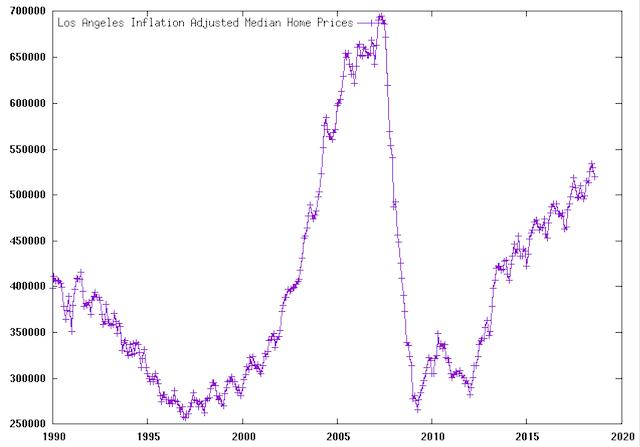
  5. Therefore home prices rose based on speculation and what the Fed recently called the "illusion" of wealth occurred.
  6. We observed a disappearance of affordable homes for sale and even cheap rentals. For many people this necessitated the use of debt.
  7. Cities enjoyed increased revenues because increased homes prices meant higher tax revenue.
  8. Many Americans who either have money or are willing to take on risky debts have become buy-to-rent operators.
  9. The inability of borrowers/spectulators to pay variable-rate mortgages has led to many foreclosures and the realization that banks possess troubled assets meaning worthless loan papers.
  10. Therefore the stock market fell from its high of 14000 to presently near 7000.
  11. Cities also speculated in the stock market and some have reported a halving of assets since the stock market fell.
  12. People who possess retirement accounts have also reported significant falls in their retirement booty.

The abusive speculators

There is a cadre of wealthy speculators who are at war with savers. Who's a saver? If work for a living and you put money into a bank for safety and to collect interest, you are a saver.

Wealthy speculators like:

  1. Borrowing at low interest.
  2. Collecting (privatizing) all of their gains.
  3. Walking away from (socializing) all of their losses.

This effectively results in a global Ponzi scheme.

Wealthy speculators dislike:

  1. Regulation on derivatives gambling.
  2. Higher bank interest rates.
  3. Higher Treasury bond interest rates.
  4. Stock dividends that are actually paid out.

Wealthy speculators use part of their ill gotten gains to bribe politicians (which is legal in the USA where we call bribes "campaign contribution" or private consultant jobs). Therefore politicians are on their side, not on the side of the savers.

John Paulson and Goldman Sachs

John Paulson is one speculator who became infamous for betting against subprime securities and massively winning. He is said by Kevin Connor to have worked with Goldman Sachs to create those fraudulent securities, designing them to fail so that he could later profit on their failure, terming this a "vulture flight pattern". In 2010, Paulson was operating in Greece with a team of 20 traders and Goldman Sachs to bet against Greek national debt.

The abused savers

Savers are regular people who hope to benefit from putting their money in banks, which effectively lends the money to banks to invest with in return for interest.

Banks pay you for the right to use your money for investments.

Without your savings, banks are unable to make loans. Fractional Reserve Lending lets them lend out 10 times the savings that they have on hand.

Savers benefit from:

  1. Higher bank interest rates.
  2. Higher Treasury bond interest rates.
  3. Stock dividends that are actually paid out.
  4. A guarantee that their money will not disappear if the bank fails.

Now that the FDIC has no money, the guarantee to savers that they formerly offered is ringing pretty hollow.

The peekaboo accounting scam

We now know that Lehman executives were, like execs at almost every US corporation it seems, engaging in "peekaboo accounting" as commentator Max Keiser calls it. This means they would move debts off their balance sheets just days before having to issue a quarterly report, and a week later move it back on.

Peekaboo accounting is also now a common practice of corporations, who move profits and debts to other organizations temporarily when reporting time comes.

Besides making profits disappear temporarily, corporations also move profits to foreign subsidiaries located in tax havens to avoid paying taxes on those profits. This practice accelerated under the George W. Bush presidency, as described in a Citizens for Tax Justice report.

The shadow banking system

Also known as the dark exchange, the after-hours market, the OTC market.
  • Every brokerage firm normally has an "error account" in which brokers' mistakes are collected. That's normal.
  • What's not normal however is that brokerages started trading "derivatives" between themselves through these error accounts. This practice expanded to become the off-the-books or "shadow banking system".
  • The shadow banking system includes derivatives trading and globally $500 trillion of derivatives debt.
  • Major players include Goldman Sachs, JP Morgan, Citibank, Morgan Stanley.
  • The shadow banking system grew larger than the legitimate, public stock market. The estimate is that it grew to $25 or 30 billion dollars in the US. But $14 trillion globally.
  • Credit default swaps and securitizing are effectively money laundering in his view.

Bank for International Settlements

Located in Basel, Switzerland. Website.

The BIS has useful statistics on the global derivatives market, which was $1200 trillion or so in 2010. BIS stats.

Market irrationalism

Market Religion

Some time ago I devised the term market religion to describe what I saw as a set of behaviors that are akin to religion, in a psychological and anthropological senses. I had been taking courses in both psychology and anthropology. Anthropologists are interested in what constitutes a religion and they generally specify a set of characteristics.

I kept seeing these key characteristics of religiousness in financial news reporting, but also in the America's ostensibly capitalist culture generally. So I began to consider capitalism to be a kind of pseudo-religion.

It was a satirical claim of course, but then again, as an atheist I often see patterns of religiousness in people, even in other atheists' behaviors and beliefs.

Market Fundamentalism

Market fundamentalism is a term that describes a collection of claims that is actively promoted by various people. Typically these people are pushing the Neoliberal agenda.

Some of these claims:

  • The market is or can be self-regulating.
  • Businesspeople can or should be self-regulating.
  • A higher stock price means a healthier or better company.

Ponzi schemes

Robbing Peter to pay Paul is the essence of a Ponzi. In a Ponzi this happens many times until the money bubble pops. Peter and Paul are usually eager participants, and are unaware of each other.

Fractional reserve lending

  • This is lending by banks of more money that they have on hand.
  • By law banks can lend out 10 times what they have in deposits.
  • It is standard practice and has been in use for 300+ years.
  • It is explained in the documentary The Money Masters.
  • It is a Ponzi scheme.

General Motors

Senator Charles E Grassley accused General Motors of using peekaboo accounting to pretend that it paid back bailout money when in truth it repaid it using yet more public money. Grassley referred to this as a "money shuffle". Depending on how many times GM robbed Peter to pay Paul, perhaps one can call their conduct a mini-Ponzi.

Bubbles

A bubble is a Ponzi scheme, created to transfer wealth to the Ponzi schemers, who then pop the bubble, and then they rush in afterward to suggest a solution for their corrupt politicians like Obama and Gordon Brown to deploy. A bubble is caused by cheap money, which lets speculators inject borrowed money into markets, inflating the value of assets like homes and dot-com businesses.

Robbing Peter to pay Paul:

  • Peter = investors.
  • Paul = dot-com executives and existing investors.

The money supply

Where does money come from literally?

There are two sources of money:

  1. Money comes into existence by being printed. This is about 3 percent of the total money supply.
  2. Money comes into existence (through Fractional Reserve Lending) by being loaned by banks. This is the other 97% of the money supply.

When banks do not lend, and/or people and businesses are too poor to borrow, the money supply shrinks. When the money supply shrinks, money becomes more expensive (hard to obtain) and the relative value of a currency can increase whereupon deflation can set in.

Deflation helps savers, because their savings will buy more stuff, but hurts speculators (like big banks), who have far more political clout. The banker-owned media tend to claim that deflation is bad. They mean it's bad for speculators.

In the USA, the bankster-controlled Obama Administration started giving billions of dollars away to corrupt, incompetent bankers and to anyone else who would accept it. This expanded the money supply but some deflation has occurred anyway in the housing sector.

In almost every other sector, from college tuition to movie tickets to apartment rents, prices have increased substantially.

What is a market maker?

This term technically means a person or company that exists in the market to provide for an orderly and fair market. They buy when others are selling and the sell when others buy. Market makers are not supposed to profit from their position, because they can see trades before they happen. And yet many do.

However the term as used by Goldman Sachs is a euphemism for thief. Goldman engages in high-frequency trading and therefore has great power over the market. They can push the market up or down on a whim because the number of trades they're doing (volume) is so large. They are closer to the core mechanisms of the market so that they can rig the market in order to never lose.

Because players like Goldman can manipulate the market in dramatic ways, they stand accused of creating panics in order to influence politicians to prevent imposition of new regulations.

Market makers are sometimes accused of being in a position to run Ponzi schemes.

Zero-reserve banking system

The banking cartel (banks and the US government) has figured out that banks can game the system so that they don't have anything on hand. A bank will obtain an asset, lend out 10 times its value, and right away sell the asset. So they have basically no risk except for the system itself. If they do experience a loss, they will employ the Neoliberal practice of going to Washington to get the politicians to have the taxpayers bail them out, paying off their bad bets. (In Neoliberalism they privatize profits and socialize losses.)

Leverage

Fractional reserve lending in analogous to the system as a whole. Big financial companies are "over-leveraged" meaning they have bets and debts greatly in excess to their real assets. However since Alan Greenspan the "fraction" has been shrinking as a percentage. This increases the risk for everyone since a stable economy is one that is built upon production (not bets and debts) and whose currency is backed by (built upon) something tangible such as a precious metal like gold and/or silver.

Bernie Madoff

  1. Madoff was probably just the tip of the iceberg.
  2. Since his situation came to light several other con men like him have been identified as well.
  3. The stock market itself for years has been pushing profit increases of 20% per year. This was not a realistic rate of return.
  4. A stock bubble is effectively (like the tech bubble or the housing bubble) a Ponzi scheme.
  5. Since the presidency of Ronald Reagan we have seen a series of economic bubbles and bubble-bursts.
  6. One of the best funds is Berkshire Hathaway run by Warren Buffett. It is considered legit.
  7. Bernie Madoff in this context used a simple scheme of offering a rate of return that was less than Berkshire Hathaway and less than short-lived Ponzi schemes of the past. Therefore it was not perceived as a scam.

Goldman Sachs has taken over the US government?

Some charge that Goldman Sachs has staged a coup d'etat. Consider:
  1. Barack Obama is loyal to them since they were his largest campaign contributor.
  2. Timothy Geithner (formerly NY Fed chief) appointed as his chief of staff a former Goldman Sachs lobbyist. Source
  3. Timothy Geithner as head of the NY Fed had the job of helping Wall Street banks like Goldman Sachs make more money which is why the worldwide economic system is at risk of collapse.
  4. Ben Bernanke is alleged to be under the thumb of Goldman Sachs.
  5. The SEC is headed up by yet another Goldman Sachs banker.
  6. Henry Paulson was a former CEO of Goldman and yet he became Treasury secretary. When he left Goldman he got a golden parachute of $500 million.

Some brokers like Goldman Sachs stand accused of deliberately selling their clients worthless products, then "shorting" these products i.e. betting that the value of those products will fall from their inflated price. In this way, they were ensured of a profit and their clients were certain to lose.

It is also worth pointing out that the controlling board of the BBC is dominated by Goldman Sachs executives, according to Max Keiser.

What are they up to?

They are said to do 1 trillion trades per hour and to make a profit of $100 million per day.

The WTC 7 connection

The controlled demolition of the World Trade Center at 5:20pm on 9/11 had a convenient effect for criminal bankers: The demolition of building 7, which most Americans have never seen nor heard of, resulted in a large loss of documents owned by foreign banks that described the value of assets. It also contained key files on the Enron investigation and other financial investigations.

Building 7 falling on 9/11:

Economic bubbles

What is an economic bubble?

A bubble is a phenomenon in which a feedback loop arises:
  1. A type of asset price goes up.
  2. Speculators form the belief that the rise will continue.
  3. Speculators buy more of this type of asset.
  4. More demand causes the price to go up.
This cycles until some event causes the majority to realize that assets of this type are overvalued and will not continue to rise.

Bubbles are often due to Ponzi schemes. Anything that is a Ponzi scheme naturally creates a bubble.

Examples of economic bubbles:

  • The Dot Com Bubble.
  • The Housing Bubble.
  • The credit crash of 2000-2008.

Since fractional reserve lending is a Ponzi scheme, it too is creating a bubble but slowly.

America's social security system is a Ponzi scheme.

Bubbles beget more bubbles

A Chinese official has admitted that China and the US are addressing the bubble problem by creating more bubbles.

Source:
Head Of China Sovereign Wealth Fund Openly Admits Asset Bubble Addressed By Creation Of More Bubbles (8/09).

Inflation

Inflation is portrayed in some Economics 101 classes as being a natural phenomenon of the market.

That's not quite correct.

It is actually also the product of a scheme invented hundreds of years ago by kings and queens and dukes who realized that there was a hard limit on how much they could tax their subjects before they would face the end of a pitchfork. So a new scheme was invented. It works as follows.

If a regular person writes a check without any money in the bank to pay for it, they risk going to jail.

If the Federal Reserve does it however, Congress thanks them for it. The Fed has the right to invent money out of thin air, because it's a central bank. Printing more money has bad future consequences those won't appear until later, Congress will have spent the money by then.

So rather than tax the public more, Congress can go to the Fed anytime and get free money. It was the same with royals.

This weakens the dollar, because of supply and demand. The more of a currency that is in circulation, the less value it has.

However printing more money also results in inflation, which erodes consumers' buying power and destoys savings. But this harm will not occur immediately.

In addition:

  1. Whoever gets the free money early and spends it right away is not affected by the inflation that will happen due to the free money being put into the economy.
  2. Whoever makes a profit by conveying or storing the free money should spend that profit sooner rather than later to avoid the penalty of inflation.
  3. But for the regular Joe Blow he will receive any trickled-down money late in the game when the inflation has had a chance to take effect. His purchasing power is reduced and he becomes poorer.
  4. In addition Joe Blow will have to help pay back the debts. So he is made poorer twice.

Thus, inflation is an indirect form of taxation in two ways.

Shady international cabal of financiers

It has been said that when Ian Fleming was writing his James Bond books he always gave them a basis in truth, albeit uncommon truth. So on some level Dr No, Goldfinger and other bizarre characters had counterparts in the real world.

For the common person who just wants to keep his or her down and live life, talk about an international cabal that is trying to shape world events will immediately illicit scoffs and condemnation of "conspiracy theories" and "tin foil hats".

Yet there seems to be historical evidence, unsurprisingly not provided by Establishment lackeys, that such Dr No wannabe's do exist and regularly meet in organizations such as the Bilderberg group, Trilateral Commission, and the Council on Foreign Relation.

Which is to say that economic bubbles are not accidents but are planned, as are Depressions, Recessions, and the like. Rich people of this ilk frequently use the term "New World Order" in public to refer to their ultimate goal.

And indeed there are many momentous events where gross malfeasance or criminality played a role behind the scenes: The creation of the Federal Reserve; the Great Depression; major economic bubbles (Dot Com, Housing, etc.); repeal of the Glass-Stiegel Act;

Since the G20 meeting in Pittsburgh people have said that the NWO goal of a "one world government" and a worldwide bank and currency is now moving ahead, with the Dr No types in control of it.

What is the Federal Reserve?

The Federal Reserve is a cartel of private banks whose members were once (around 1910) known as the Money Trust.

The public despised them and wanted to break their parasitic grip on society so the Money Trust members pulled a fast one: They met secretly on Jekyll Island (Georgia) to write the Federal Reserve bill. They then used trickery to get it passed in Congress as a bill to break their own hold on the economy.

Woodrow Wilson foolishly signed it into law, which he later admitted was a grave mistake.

The Federal Reserve Act indeed legalized and enshrined the Money Trust as the Federal Reserve.

The purpose of any cartel is to reduce competition between members preferably to zero while increasing profits and reducing risk for members. The Federal Reserve Act did that.

The US government is fully in on the scam: The government is an active member in the cartel.

Derivatives

Definition

A derivative is a gamble.
  1. A derivative is a financial instrument (a contract) whose value is determined by something else which is called the underlying.
  2. Derivatives are essentially bets that the value of the underlying item will go up or down. They are a kind of gambling. The underlying can be any of these:
    • An asset such as a stock or real estate or loan.
    • A stock index or other index e.g. Consumer Price Index.
    • The price of grain.
    • The weather.
    • Etc.
  3. There are four kinds of derivatives:
    • Futures = a contract to provide goods at a specific price in the future e.g. grains.
    • Forwards
    • Swaps
    • Options
  4. A recent tally by the Bank of International Settlements was that there exists $700 trillion in derivatives.
  5. Warren Buffett recently referred to derivatives as weapons of mass financial destruction.
  6. Buffetts firm Berkshire Hathaway has $63 billion of "exposure" to derivatives.
  7. Another tally from March 2009 was that the world total of derivatives was near $1.2 quadrillion. This is much more than the world GDP. (The US GDP is $14.2 trillion.)
  8. This sum has been referred as a "ticking time bomb."

OTC = over the counter

This odd term refers to any transaction that does not have a middleman.

When you buy a car from another person as a private sale, that is an example of an "over the counter" transaction. Transactions negotiated through Craigslist classified ads and on Ebay are often OTC as well.

When you buy a stock on the stock market, this is not OTC. There is an intermediate (the market) who will sell you stocks even if there is no one selling to it. Likewise you can sell to the intermediate even if there is no buyer. The intermedate functions as a market maker.

OTC can be risky for society if some party buys a highly risky product like a mortage-backed security without understanding that it's junk, and then asks society to bail them out.

Mark to market is the act of defining the market value of a contract. Some companies, realizing that an objective value could not be set, abused the mark to market concept to engage in accounting fraud.

The insurers

  1. AIG convinced itself that it would be a good idea to insure against a kind of derivative called a credit default swap.
  2. This is a type of "insuring against loss." Imagine that you go to a casino to gamble. But you bring an insurance agent with you to ensure that if you lose at poker then the insurance company will pay for your loss.
  3. So long as you the gambler are guaranteed to win the insurance company has no risk and any insurance premium that you pay is free money for them.
  4. A credit default swap is a deal in which a lender seeks insurance on a loan but does not want to make insurance premium payments. If the loan goes bad the deal is that the insurer buys the troubled loan from the lender.
  5. AIG insured so much of these credit default swaps because these are unregulated and at the time AIG believed that there was little or no risk involved in insuring them.
  6. In other words AIG thought it could use CDSes to get free money.
  7. When the global meltdown began AIG found its goose was cooked and unfortunately the US taxpayer has been giving them money to pay for their bad thinking and massive losses.
  8. Insuring against loss is not a new idea. It has happened with every economic bubble and has caused huge destruction every time. Yet Congress will not outlaw it.

Program trades

A program trade is a trade brought about by a computer program. They are advantageous in certain situations.

What certain situations? Arbitrage, from microsecond to microsecond or millisecond to millisecond.

On the New York Stock Exchange, 70% of the trades are program trades.

Of that 70%, 50% are by Goldman Sachs.

Therefore, 35% of the volume on the NYSE is Goldman Sachs program trades.

Another major program trader is Citadel.

The mid-2009 scandal to do with Goldman Sachs software being stolen by a worker proved that Goldman is using program trades to reap $100 million per day, which is a collossal rigging of the market.

Naked short selling

There's a technique called "naked short selling" that is used to literally counterfeit a company's stock in order to make a profit by selling that fake or phantom stock. In the process, its price is driven down and that negatively affects whatever company is the victim of a naked short attack.

  • In a normal "short" sale, you borrow stock and then try to sell it for less money. If you sell, you must deliver what you sell.
  • In a naked short, you don't borrow anything and if you sell it, you don't deliver. So it's totally fraudulent. But Wall Street loves it.

It is because of naked short selling that Bear Stearns' stock and Lehman Brothers' stock plummeted and each declared bankruptcy. They were the victims of fund managers orchestrating a coordinated attack on their stock using naked shorting.

It's not just banks that have been victims. Many companies have including Overstock.com, as explained by its CEO in this Fox News interview of David Byrne.

The SEC identified decreed that 19 banks to be protected from naked shorting. What this really meant was that the SEC was in all other cases and prior to that new rule refusing to enforce the laws against naked short selling, which is definitely an illegal activity.

Why? Because the people and companies who profit from naked shorting are very powerful. Indeed, according to David Byrne 9 of the protected banks were engaging in naked short selling.

Here's a YouTube video posted by WriterJudd about the naked-short-selling attacks on Bear Stearns and Lehman:

Notice that in this video the author (presumably WriterJudd) identifies three hedge fund managers whom he believes are guilty of the Bear Stearns and Lehman attacks:

  • Jim Chanos
  • Dan Loeb
  • Steven Cohen

Hedge fund transactions may constitute 50% of the trades on the NYSE.

Counterfeit ratings

Everyone knows that mortgage-backed securities were fraudulent. So why did organizations, towns, cities, and countries buy them?

Because ratings agencies like Moody's were paid more to provide better ratings of these securities. It was fraud.

This established the mortgage-backed securities as a "confidence game", i.e. one in which a victim is made to feel confident that something is worth a great deal of money when actually it's fairly worthless.

Source

The unemployed

The official unemployment number is bogus because it ignores people who are working only part-time and people who have stopped looking for work.

So while the official rate as of July 2009 is 9.5% the truth is it's more like 16%.

The Chinese lenders

  • China has about $1.5 trillion of US dollars the value of which falls when the dollar falls and whenever the Fed prints more and more money.
  • China holds about $2 trillion in foreign exchange reserves overall.
    Source: FT article.
  • China has $500 billion that is mortage-backed securities from Fannie Mae and Freddie Mac.
    Source: NYT article.
  • China can use this debt to demand key assets such as income-producing properties in the USA. For instance toll roads.

The Wall St. fraudsters

There are supposedly at least 16 types of fraud that are in commonplace use on Wall Street. Many of these techniques are old, others are Enron-inspired, but they are common and are used by Wall Street firms to steal from the public.

World debt versus world GDP

  • The total of all GDPs of all nations in the world is only $100 trillion versus the US GDP of $13 trillion.
  • The total debt in the world is something like $1000 trillion (a quadrillion).

The US dollar

It's the world reserve currency. But for how long?
  • Oil and gold are traded in US dollars.
  • The dollar-based financial markets are the "deepest". It involves $50 trillion.
  • China has been buying up gold bars apparently in order to strenghen the importance of the yuan.

Dollar devaluation

In October 2009, journalist Robert Fisk announced that China, Fruance, Russia, oil producing countries and Gulf states had met secretly to discuss dumping the US dollar as the currency for trading oil.

This is the "decoupling effect" that Peter Schiff warns will happen.

It is known that China has been quietly accumulating gold. Gold has an inverse relationship with the dollar.

It is known that Gulf states have about $2 trillion dollars of reserves.

63% of worldwide reserves of foreign currencies are US dollars according to Russia Today in October 2009.

The Carry Trade

Interest rates are not the same in every country. If you see that the interest rates are low in country A, such that you can borrow cheaply, and that investments exist in country B that are offer a higher rate of return, then you can make money by borrowing in one currency, exchanging it, and investing in country B. This is the carry trade.

If the interest rates rise in country A, the carry trade disappears and investors are left with bad investments.

The carry trade was instrumental in Iceland's unlikely rise. The carry trade is how they made money without producing anything and despite Iceland's tiny population of only 300,000 people.

The carry trade can explain why the dollar has risen recently even while the stock market fell. The dollar was in demand because it's cheap to borrow. Interesting commentary by Jan-willem Nijkamp.

Gold

  • China has 600 tons of gold bullion.
    • China has for some years been quietly buying gold whenever the price dips.
  • USA has 8000 tons of gold bullion.
  • IMF has 1000 tons of gold bullion.
  • German gold is in New York.
  • Hong Kong has demanded its gold back from London.
  • The French took their gold back from New York a few decades ago.
  • The total value of all gold in the world is about US $4 trillion.

The "Beijing put" refers to China's purchasing of gold whenever it falls below $1000 per ounce. It does so quietly so as to not send the price higher. Thus it buys in the valleys i.e. when the price dips.

Places

London

  • London has been the center of world hedge fund industry.
  • Gordon Brown pushed to relax the rules (weaken regulations) for the City of London.
  • Gordon Brown made the City of London the least regulated financial center in the world.
  • AIG based its credit-default-swap (CDS) operations in London.
  • The UK provides "safe haven" for money launderers.

The future: What could happen?

Peter Schiff says...

Schiff is the former economic advisor to US presidential candidate Ron Paul. He regularly appears on mainstream media news shows to provide his opinions and debate the big wigs. He believes there will be a "decoupling effect" in which the US dollar will cease to be the world's reserve currency and will be abandoned.

At his point both Russia and China have argued that the US dollar should be abandoned as the world reserve currency.

Jim Rogers says...

His website

Rogers is a famous investor and frugal man who has "little need for money". He and friend George Soros won big when trading currency during their younger years. Rogers warns everyone to get out of the US dollar and the UK pound. He has famously told young Britons to leave the UK.

Michael Hudson says...

His website

Michael Hudson explains the meltdown: KPFA Guns and Butter interview MP3.

Michael Moore

Moore's 2009 film "Capitalism, a Love Story" brings the details of the derivatives mess and the threat of corporatism to the public's doorstep.

He does a pretty good job considering that he makes mainstream American films and is surely constrained from speaking verboten topics.

Yet what he doesn't say is almost more important than what he does. He fails in this documentary to mention:

  • The $23.7 trillion in bailouts that Neil Barofsky has warned of.
  • The $2 trillion of loans to unknown parties that the Fed issued and which Bloomberg sued over.
  • The fact that the Fed was begun by and is today run by the major corrupt banks that he mentions.
  • The ongoing and increasingly successful effort to audit the Fed.

Africa

The Neoliberal system takes the resources of Africa and gives them aid and guns in returns. You can no longer say it's "the West" doing it, since China is in on the game.

Reminder: Our corrupt media

We live in an age of huge scams. Massive wrongs are being committed or have been and few people are being held accountable. Events have shown that Obama is in on the racketeering and the cover-ups. He is providing a continuation and expansion of George W. Bush's disastrous policies, not just in the area of finance but also in the building-up of the police state.

Both the mainstream media and the carefully-named alternative media (who are not truly independent as they are funded by corporate foundations) have to varying extents been active in covering up the facts about all the major scams that have been in play and thereby in protecting the guilty.

For info about who controls the alternative media, see here: diagram

Finance Jargon

  1. Great Fool Theory = people who understand risks more will dump their assets onto people who understand risks less e.g. you know your car is broken therefore you sell it to some fool.
  2. Short selling ("shorting") = a bet in which you borrow something (you do not own it) and sell it in the hope of buying it back at a profit when the price falls. If the price rises then you lose money.
  3. Naked short selling = an attack on a stock (such as Bear Stearns or Lehman) that drives its stock price down short-term so that the attacker can profit from a put option i.e. a bet that the price will go down.
  4. Market liquidity = When the exchange itself serves as a buyer or seller to ensure that buyers and sellers can always find a partner for a transaction -- irregardless of whether both buyers and sellers (other than the exchange) are present.
  5. Quantitative easing = The act of creating inflation by printing too much money. Why do that? Because the USA cannot pay back its national debt. Every time the Fed prints more dollars it is decreasing the value of the dollar itself (supply and demand) and since that debt is denominated in dollars the value of the debt decreases.
  6. Black swan = an event that deviated significantly from the norm but that is hard to predict e.g. results of an inside job.
  7. To "front run" = trading based on inside information.
  8. Moral hazard = When one party acts more riskily because they know they are insulated from loss by another party. This has occurred with the US financial bailouts. When profits are privatized but losses are socialized this is moral hazard since the public is paying off the losses of the risky-taking bankers.
  9. Carry trade = Borrowing money in a low-interest currency and then exchanging it to invest it in another, higher-interest currency.
  10. Mark to market = assigning value to an OTC (over the counter) derivative.
  11. Front running = when a broker puts his own trade in front of a client trade. Link
  12. Dead cat bounce = Creating a fake rally in the market just before the real shit hits the fan in order to pull in the gullible suckers who wish and wish so hard that the crisis is already over and will part with their money easily.
  13. Painting the tape = Creating a fake end-of-day rally in a stock so that the news media will claim in the evening/morning news tht the stock is now popular even though no real value has been added.
  14. Margin = money paid to an exchange to be used in the event of a trading loss.
  15. Margin call = use of a margin in the event of a trading loss.
  16. Put option = contract saying you may sell X at price Y for a period of time. X is the "underlier". Y is the "strike price". If Y > spot price then you win.
  17. Call option = contract saying you may to buy X at price Y for a period of time. X is the "underlier". Y is the "strike price". If Y < spot price then you win.
  18. Straddle = a put combined with a call. You win more money than you bet if the price goes outside of a range. Otherwise you lose and the seller keeps your money.
  19. Breakeven point = the point at which the costs of making a transaction equals the profit/gain achieved by the transaction.
  20. White shoe = mafia-like bankster behavior concealed by a veneer of light-skinned Protestants.
  21. Weenie waving = making stock market gambles just to show you are big stuff.

For reference: Gold price


gold price charts provided by goldprice.org And oil too:

A poem

It seems that America is toast
All ruined not unlike our East Coast
There may be a silver lining
For our empire needs confining
Our greatness is an empty boast.

Documentaries about the financial crisis

Animations:

About student loans:

About the rich:

A few links

Links